The Eye of the Sahara: Why That Giant Circle in Mauritania
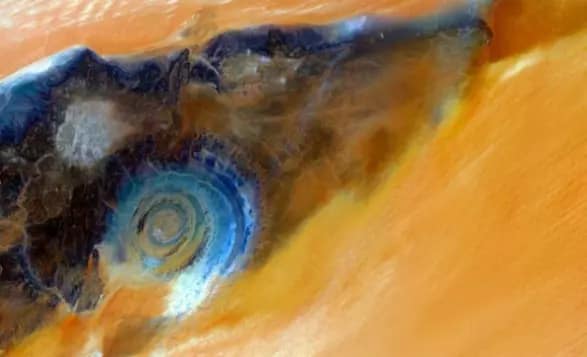
If you scroll through satellite images of the Sahara, it’s hard to miss. You will see a huge, almost perfect circular formation that looks exactly like a giant eye looking up from the desert. Most people know it as the Eye of the Sahara or Eye of Africa. Experts call it the Richat Structure. It lies in central Mauritania on the Adrar Plateau and spans roughly 40 to 50 kilometers across.
Astronauts first noticed this unusual landmark during the early space missions in the 1960s. From orbit, it stands out clearly against the flat desert. However, on the ground the full pattern is much harder to see. You need some elevation to appreciate the concentric rings properly.
For many years, people believed a massive meteorite created this structure. The round shape with clear rings looked too perfect. But detailed geological studies proved them wrong.
The Richat Structure is an ancient eroded dome that rose from the ground about 100 million years ago. Molten rock pushed upward from deep below and lifted the rock layers. Then, over millions of years, strong Sahara winds and sand slowly eroded the dome. Harder rocks resisted erosion and formed the visible rings we see today.
What Makes This Formation Special
You can find older rocks in the center, while younger layers form the outer rings. This pattern differs completely from real meteorite craters. Scientists found no shocked quartz or melted glass — typical signs of an impact. A 2024 study confirmed that the structure developed through several stages of magmatic activity.
The same winds that shaped these rings also lift huge amounts of dust every year. NASA calls this phenomenon the Saharan Air Layer. From late spring to early fall, this dry dusty air crosses the Atlantic Ocean. It can reach the Caribbean and the United States, where it creates beautiful sunsets but sometimes causes breathing problems and weakens developing hurricanes.
Even though experts debunked the meteor theory long ago, the Eye of the Sahara still attracts attention. Some people link it to Atlantis because of the rings, but the real geological story is impressive enough. In 2022, experts added it to the list of the world’s most important geological heritage sites.
Today, only a few adventurous travelers visit the site by 4×4. For most people, the Eye of the Sahara remains a mysterious perfect circle visible only from space. It reminds us how slowly and patiently our planet reshapes itself over millions of years.
Based on images obtained by NASA‘s Earth Observatory and the latest geological research, ECOnews reports.