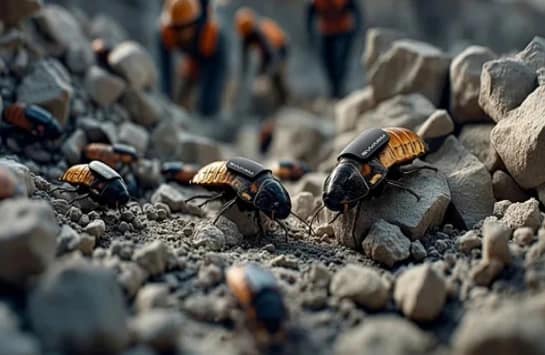
NATO Deploys Programmable Cyborg Cockroach Swarms from German Startup SWARM
German startup SWARM just announced a game-changing deployment. They now supply programmable cyborg cockroach swarms directly to NATO forces. According to the Army Recognition portal, the company has already delivered these systems to paying customers, including the German Bundeswehr. This happened right after successful field trials across Europe and the United States.
SWARM Biotactics equips living Madagascar hissing cockroaches with ultralight “backpacks.” These tiny devices weigh only 10–15 grams and contain cameras, acoustic and chemical sensors, microcontrollers, power supplies, and neurostimulation electrodes.
Operators simply send electrical impulses to control the insect’s movement, speed, and behavior in real time. Moreover, the insects still keep all their natural abilities—they stay completely silent, move with incredible agility, and navigate tight spaces without any GPS.
Why Cyborg Cockroach Swarms Excel in the “Last 50 Meters” of Combat
Traditional micro-drones often fail in the final 50 meters of urban fighting, tunnels, or collapsed buildings. They make noise, lose signal, get stuck, or get jammed. In contrast, SWARM’s cyborg cockroaches silently slip through millimeter gaps, climb walls, and deliver real-time intelligence.
The swarms collect data on targets, equipment, and signals—either autonomously or under direct operator control. Additionally, they transmit compressed information through secure low-power channels using edge-AI processing.
However, the technology still has limitations. Low-power signals from the insects can be suppressed by compact electronic warfare systems. For now, the swarms focus purely on covert surveillance and reconnaissance. Despite this, the system already opens powerful new possibilities for NATO troops in city battles and underground operations.
SWARM Biotactics continues to improve the technology. They plan to add more sensors and enhance swarm autonomy in the coming months. This bioelectronic approach clearly outperforms traditional drones in GPS-denied and cluttered environments.
Source: Army Recognition portal