South Atlantic Anomaly 2025–2026: Earth’s Magnetic Field Weakening Faster Than Expected – Insights from ESA’s Swarm Mission
Earth’s magnetic field acts as an invisible geomagnetic shield, safeguarding the planet from solar wind and cosmic rays. However, recent data from the ESA Swarm mission reveals that the weakening of Earth’s magnetic field is accelerating beyond predictions.
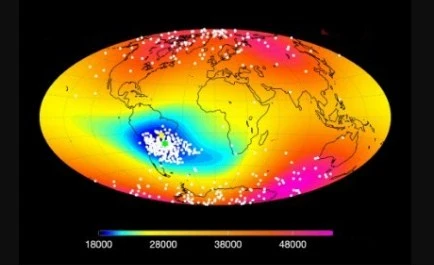
The primary concern is the South Atlantic Anomaly (SAA), a vast region of diminished geomagnetism over the southern Atlantic Ocean. From 2014 to 2025, this anomaly has expanded to cover an area nearly half the size of continental Europe.
What is the South Atlantic Anomaly and Why It Matters
The South Atlantic Anomaly is a zone where magnetic field intensity drops to critically low levels (below 26,000 nT). First observed in the 19th century and studied in detail since the 1950s via satellite measurements, it spans the southern Atlantic, parts of South America, and southern Africa. In this area, the geomagnetic shield is weaker, allowing more charged particles from space to penetrate.
The implications are significant: Satellites traversing the anomaly over the Atlantic experience heightened radiation, leading to electronic malfunctions, sensor errors, and potential equipment failures (e.g., on the ISS and Hubble Space Telescope).
Here’s how the South Atlantic Anomaly appeared in 2014 versus 2025 based on ESA Swarm data:
On the left (2014) and right (2025) maps, the expansion of the weakened zone (dark blue) is evident, particularly toward Africa. The expansion of the South Atlantic Anomaly is most notable in the southwest African sector.
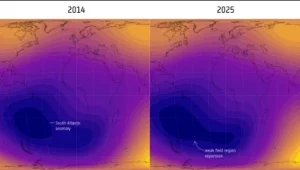
Latest Swarm Mission Data: Changes from 2014 to 2025
The Swarm satellites (three in orbit since 2013) provide high-precision magnetic field measurements. According to ESA’s October 2025 report in the journal Physics of the Earth and Planetary Interiors:
- The anomaly zone has grown to a size comparable to half of Europe.
- Weakening has accelerated since 2020, especially southwest of Africa.
- Changes are uneven: more stable near South America, more dynamic over Africa.
- Contrasting patterns elsewhere: pronounced weakening over Canada (0.65% reduction in strong field area), strengthening over Siberia (0.42% increase).
February 2026 analyses confirm: Minimum field intensity in the anomaly has reached record lows.
Causes of the Changes: What’s Happening in Earth’s Core
The magnetic field is generated by the dynamo effect in Earth’s liquid outer core—convective flows of molten iron. Scientists link the weakening of Earth’s magnetic field to reverse flux patches at the core-mantle boundary. One such patch is drifting westward under Africa, intensifying the weakening in that region.
This creates a mosaic pattern: Changes are localized, reflecting complex turbulent flows in the core.
Potential Consequences for Humanity and Space
The diminishing geomagnetic shield heightens risks:
- Increased radiation for satellites → disruptions in GPS, communications, and solar panels.
- Amplified space weather effects → threats to orbital infrastructure.
- Long-term outlook: Some experts see signs of an impending magnetic pole reversal (last one ~780,000 years ago), but this process would span millennia without immediate catastrophe.
Swarm data aids in updating magnetic field models (e.g., IGRF), essential for navigation and space missions.
Historical Context and Ongoing Monitoring
The SAA has been known since the 19th century, but it has shifted westward, restructured its shape, and altered weakening centers over time. Early detections came from compass anomalies during sea voyages, later confirmed by satellites like Ørsted and CHAMP before Swarm.
Recent studies suggest links to ancient core dynamics, possibly influenced by mantle plumes or slab subduction. For instance, a 2024 Nature Geoscience paper proposed that African low shear velocity provinces contribute to the anomaly’s persistence.
Impacts extend beyond space: On Earth, weakened fields could increase atmospheric ozone depletion or affect animal migration (e.g., turtles and birds using geomagnetism for navigation). However, human health risks remain low due to atmospheric protection.
The South Atlantic Anomaly exemplifies the dynamic nature of Earth’s interior. The ESA Swarm mission continues observations, with 2026 data affirming accelerated changes. Tracking Earth’s magnetic field changes 2025 is vital for technological safeguards and planetary understanding. For more details, visit the official ESA site: esa.int/Swarm.
Keywords for search: South Atlantic Anomaly 2025, weakening of Earth’s magnetic field, ESA Swarm mission, expansion of South Atlantic Anomaly, geomagnetic shield, anomaly over Atlantic, radiation for satellites, magnetic pole reversal.