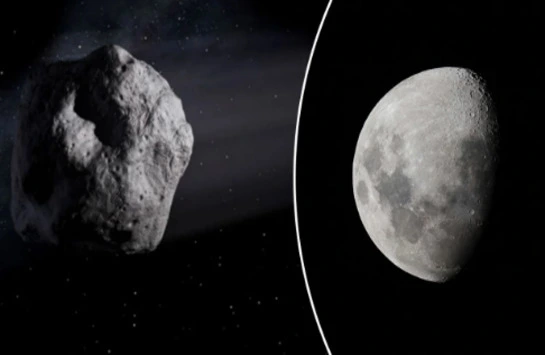
Asteroid 2024 YR4 Won’t Hit the Moon in 2032
Astronomers can finally breathe a sigh of relief: asteroid 2024 YR4 is not going to hit the Moon in 2032.
The James Webb Space Telescope put the last piece in the puzzle. New infrared observations on February 18 and 26, 2026, allowed NASA specialists to refine the orbit with high precision. The updated trajectory shows the asteroid will pass the Moon at a safe distance of roughly 21,000 kilometers on December 22, 2032. Close in space terms, but still far from any danger.
Earlier estimates had given a 4.3% chance of impact—low, but enough to make some headlines. Now that chance is zero. Clean miss.
The asteroid is about 60 meters across — roughly the height of a 15-story building. Had an impact occurred, we’d be looking at a crater almost 2 km wide and a significant amount of debris in lunar orbit. That would’ve been quite a sight from Earth with a decent telescope. But thankfully — no.
Earth was never really at risk; that possibility was ruled out back in early 2025. The lunar scenario lingered longer because the asteroid slipped out of view for ground-based telescopes after spring 2025. JWST’s infrared was the only thing that could track it again.
Very interesting video from NASA. JWST Reveals Asteroid with 4.3% Moon Impact Chance.

This Kind of Thing Happens All the Time in Asteroid Tracking
Take Apophis, for example — discovered in 2004, everyone was worried it might hit Earth in 2029 or 2036. Then better observations came in and the risk vanished. Same here: more precise data, no drama.
Honestly, I’m glad. For a moment some people were worried this rock might cause a spectacle on the Moon — but it won’t. Just another quiet flyby.
Sources: Science Alert. NASA/JWST orbital update, February 2026. ATLAS discovery announcement, late 2024.
I previously wrote about Greenland’s largest glacier, Jakobshavn, which is currently in danger. A new study claims it could soon cross a critical threshold.
Chief Editor Alex Seko.